Artificial intelligence is no longer a future initiative. Most organizations have already experimented with AI. The harder part is turning that experimentation into measurable operational value.
Executive Summary
Most organizations have tested AI through tools like ChatGPT, Microsoft Copilot, Gemini, Claude, or industry-specific solutions. Teams are generating content faster, summarizing documents, analyzing data, and automating repetitive tasks.
Yet despite growing investment, many organizations struggle to move beyond isolated successes.
The issue is not access to AI technology. The issue is operationalizing it.
| Insight | Impact |
|---|---|
| Most AI initiatives fail after the pilot stage | Technology alone does not create business value. |
| Data quality matters more than model selection | AI requires reliable information to produce useful outcomes. |
| System integration is critical | AI cannot operate effectively in disconnected environments. |
| Governance enables responsible adoption | Security and compliance cannot be an afterthought. |
| Adoption determines ROI | AI only creates value when people consistently use it. |
The Four Foundations of Successful AI Adoption
Organizations that successfully move from experimentation to operational AI consistently demonstrate strength across four foundational capabilities: data, systems, governance, and adoption.
Weakness in any single area can limit the effectiveness of the entire initiative. Strong data does not help much if systems are disconnected. Modern systems will not create value if employees do not use them. Governance cannot be an afterthought once AI becomes part of daily operations.
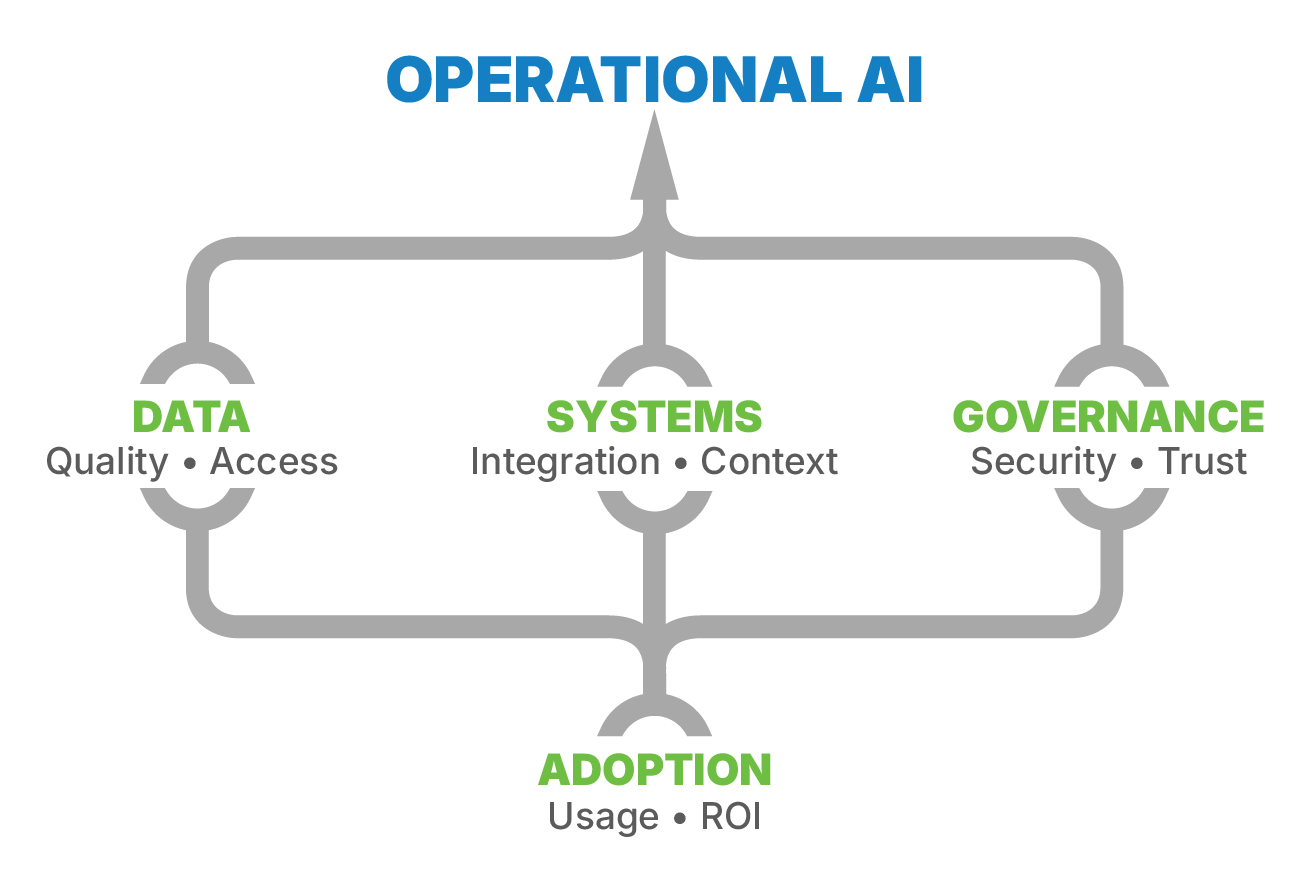
The Four Foundations of Successful AI Adoption help organizations evaluate whether they are ready to move from AI experimentation to operational AI.
| Foundation | Core Question |
|---|---|
| Data | Can AI access accurate, relevant information? |
| Systems | Can your technology stack support integrated AI workflows? |
| Governance | Can AI be deployed securely and responsibly? |
| Adoption | Will people actually use it? |
Why Most AI Initiatives Stall
The typical AI journey follows a familiar pattern.
A team identifies an opportunity. A pilot project is launched. Initial results look promising. Excitement builds.
Then progress slows.
The pilot never scales. Adoption plateaus. Measuring ROI becomes difficult. Leadership begins questioning the investment.
This is not usually a technology problem. In most cases, stalled AI initiatives can be traced back to foundational gaps within the organization.
AI cannot solve disconnected systems.
AI cannot overcome inaccessible data.
AI cannot compensate for poor governance.
AI cannot create value if employees do not trust or use it.
The organizations achieving measurable outcomes from AI are building the operational foundation required for long-term success.
What AI Readiness Actually Means
Many organizations think AI readiness begins with selecting a platform.
In reality, AI readiness begins long before a model is deployed.
Organizations that successfully move from experimentation to operational AI consistently demonstrate strength across four foundational areas.
Are employees equipped to use AI effectively?
Is adoption being measured?
Are teams seeing tangible benefits?
The Four Stages of AI Adoption
Organizations generally progress through four stages as AI maturity increases.
Stage 1: Exploration
Teams experiment with tools like ChatGPT, Copilot, Gemini, or Claude. The goal is learning and discovery.
Stage 2: Department-Level Adoption
Specific teams integrate AI into workflows such as content creation, support, development, research, and analysis.
Stage 3: Integrated AI
AI connects to business systems, organizational knowledge, operational data, and workflow automation.
Stage 4: Operational AI
AI becomes embedded within day-to-day operations, decision support, predictive analytics, and continuous optimization.
Building the Data Foundation
Of the four foundations, data is often the most important.
Organizations cannot operationalize AI if critical information is inaccessible, inconsistent, or unreliable.
Data Accessibility
Can information be located when needed?
Data Quality
Can information be trusted?
Data Consistency
Do systems define information the same way?
Data Ownership
Who is responsible for maintaining accuracy?
Organizations frequently discover that improving data quality delivers measurable operational benefits long before AI deployment begins.
Why System Integration Matters
Systems represent the second foundation of successful AI adoption.
This is also where many organizations encounter their biggest challenges. Information exists across CRM systems, ERP platforms, warehouse systems, customer portals, financial applications, and business intelligence platforms.
Employees spend significant time gathering information from multiple sources. AI faces the same challenge.
Without integration, AI lacks context.
This is why integration technologies such as APIs, workflow automation, and emerging standards like Model Context Protocol are becoming increasingly important.
Rather than forcing employees to search across systems, integrated AI solutions can access relevant information and deliver actionable insights within existing workflows.
Organizations that solve integration challenges often unlock dramatically greater value from their AI investments. This is why technologies such as APIs, workflow automation, and Model Context Protocol (MCP) are becoming increasingly important. Rather than forcing AI systems to operate in isolation, MCP helps connect AI to the business context stored across applications, databases, and operational systems.
What Is Model Context Protocol (MCP)?
AI Governance and Security
Governance represents the third foundation of successful AI adoption.
As AI becomes more deeply integrated into business operations, organizations must establish clear rules and accountability.
Key considerations include data access permissions, security controls, privacy requirements, compliance obligations, human oversight, and auditability.
Organizations that establish governance early often scale AI faster because employees and leadership trust the systems being implemented.
Good governance should accelerate adoption, not prevent it.
Measuring AI ROI
Adoption is the fourth foundation of successful AI implementation.
Without measurable outcomes, organizations struggle to justify continued investment. Successful organizations establish baseline metrics before deployment whenever possible.
| Measurement Area | Example Metrics |
|---|---|
| Productivity Improvements | Time saved, work completed, reduced manual effort |
| Operational Improvements | Faster workflows, reduced processing costs, fewer bottlenecks |
| Customer Experience | Faster response times, higher satisfaction scores, improved resolution rates |
| Revenue Impact | Increased conversion rates, better retention, new business opportunities |
Common AI Adoption Mistakes
Focusing on Tools Instead of Outcomes
Organizations chase technology without clearly defining business objectives.
Ignoring Data Challenges
Poor information quality limits the effectiveness of AI regardless of the model being used.
Treating AI as a Standalone Project
AI adoption is an operational transformation initiative, not a software purchase.
Underestimating Integration Complexity
Disconnected systems limit AI effectiveness.
Neglecting Change Management
Employees need education, support, and trust before adoption can succeed.
A Practical AI Adoption Roadmap
- Assess the Four Foundations: Evaluate Data, Systems, Governance, and Adoption.
- Identify High-Value Opportunities: Focus on measurable business outcomes.
- Modernize and Connect Systems: Address integration barriers and information silos.
- Establish Governance: Create policies, ownership structures, and oversight processes.
- Launch Focused Initiatives: Start with achievable use cases that produce measurable results.
- Scale Successful Implementations: Expand adoption across departments and workflows.
- Continuously Improve: Treat AI adoption as an ongoing capability, not a one-time project.
Not Sure Where Your Organization Stands?
Before investing in another AI tool, assess whether your data, systems, governance, and adoption strategy are ready to support operational AI.
Envative's AI Readiness Assessment can help identify where your organization is prepared, where risk exists, and what needs to happen next.
Take the AI Readiness AssessmentConclusion
The conversation around AI is maturing.
The question is no longer whether organizations should experiment with AI.
The question is whether they can operationalize it effectively.
Organizations that achieve lasting success rarely do so because they selected a better model. They succeed because they built strong foundations.
Data. Systems. Governance. Adoption.
When those four foundations are aligned, AI can move beyond experimentation and become a measurable driver of operational performance, efficiency, and competitive advantage.
Technology matters. The foundation determines success.
Frequently Asked Questions
What is AI adoption?
AI adoption is the process of integrating artificial intelligence into business operations, workflows, and decision-making processes to improve efficiency, productivity, and outcomes.
Why do AI projects fail after the pilot stage?
Most AI projects fail because organizations lack the data, integrations, governance structures, or organizational readiness required to scale successfully.
What is operational AI?
Operational AI refers to AI systems embedded within everyday business processes that consistently deliver measurable business value.
How do you assess AI readiness?
Organizations should evaluate four key areas: Data, Systems, Governance, and Adoption. Weakness in any one area can limit the success of AI initiatives.
Why is system integration important for AI?
AI requires access to business context. Integrated systems provide the information necessary for AI to support workflows, decision-making, and automation.
How should organizations measure AI ROI?
Organizations can measure AI ROI through productivity gains, operational efficiencies, customer experience improvements, cost reductions, and revenue growth depending on the use case.
Tagged as: AI, MCP

About the Author:
Craig Lamb is a co-founder and serves as Chief Information Officer at Envative, a software development company offering custom end-to-end solutions in web, mobile and IoT. With over 25 years of experience in Information Technology leadership, he is a researcher and promoter of new technologies that are leveraged in Envative's custom development efforts. Craig's expertise and keen insights have made him a respected leader and an engaging speaker within the tech industry. His greatest source of professional achievement, however, is on the consultative and technologically advanced business culture that he (along with his business partner, Dave Mastrella) has built and cultivated for more than two decades.