INDUSTRY: All
The Hidden Architecture Bottleneck Slowing Your Organization
Every leadership team eventually asks the same question:
Why does every strategic initiative take longer than it should?
Not longer than the plan.
Longer than common sense.
-
A pricing change takes months.
-
A customer portal enhancement gets stuck in backlog.
-
The AI pilot works perfectly in demo — then fails in production.
-
Integration projects stall in endless data mapping.
At some point, the conversation shifts.
Leaders stop asking “When will this ship?”
They start asking:
“Why is everything so hard to change?”
The answer usually isn’t effort.
It’s architecture.
What This Whitepaper Explores
This whitepaper explains the hidden architectural constraints that slow modern organizations down, even when they appear to have modern technology stacks.
Most companies didn’t design their systems for adaptability.
They designed them for stability.
-
Transaction processing
-
Order management
-
Inventory tracking
-
Claims handling
-
Billing cycles
These systems work.
They process transactions.
But they were never designed for constant evolution.
Modern organizations now demand:
-
Rapid workflow changes
-
AI-driven decision layers
-
Expanding integrations
-
Custom differentiation
-
Real-time experimentation
That tension creates architectural drag.
Signs You’re Experiencing Architectural Drag
If these feel familiar, the bottleneck may not be your tools.
It may be your architecture.
Common symptoms include:
-
IT backlogs that never shrink
-
CSV exports between “integrated” systems
-
Business logic hidden in spreadsheets
-
Custom rules layered outside core platforms
-
AI tools that can’t access clean data
-
Vendor roadmaps dictating your timeline
Most organizations normalize these problems.
Until speed becomes critical.
The Real Constraint Behind Slow IT Projects
The speed of a modern organization comes down to one fundamental capability:
How easily can you change workflows and move data?
If the answer is “with difficulty,” everything slows down.
Adding more technology doesn’t fix the problem.
In fact, it often makes it worse.
-
AI layered onto rigid architecture accelerates confusion
-
Automation layered onto fragmented data accelerates inconsistency
-
More vendors layered onto weak integration increases complexity
Without intentional architecture, modernization efforts compound friction instead of removing it.
What You’ll Learn in This Whitepaper
Inside the whitepaper:
Why enterprise systems resist change
Learn why systems optimized for reliability often create barriers to adaptation.
The hidden cost of architectural drag
Understand how slow technology affects margin, customer experience, and innovation.
Why most modernization efforts fail
Discover why upgrading tools rarely solves structural problems.
How to identify architecture bottlenecks
A simple test to determine whether your systems were designed to evolve or simply process transactions.
Who Should Read This
This whitepaper is especially relevant for:
-
CIOs and CTOs
-
Technology leaders
-
Digital transformation teams
-
Operations executives
-
Enterprise architects
-
IT modernization leaders
If your organization struggles with slow integrations, long IT backlogs, or stalled innovation, this paper will resonate.
The Question That Matters
Before launching your next transformation initiative, ask:
Is your architecture designed to process transactions…
or
designed to evolve?
Because if your systems were built for stability alone, every strategic change will feel heavier than it should.
And that weight compounds over time.
Download the Whitepaper
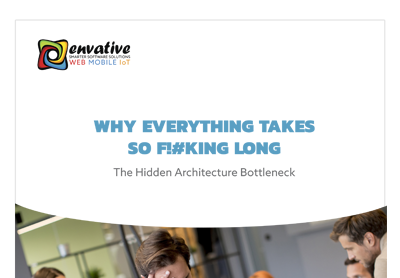
Why Everything Takes So F!#king Long: The Hidden Architecture Bottleneck
A short, direct exploration of why modern organizations struggle to move quickly — and what’s actually behind it.
Download the whitepaper to understand:
-
Where architectural drag comes from
-
Why IT backlogs never disappear
-
Why AI and automation fail to scale
-
What architecture designed for adaptability actually looks like